Setting a trend for the rest of the journey, on Tuesday, February 28, we woke up early. Following a hearty breakfast, we boarded the bus driven by Jihad and began our tour of Tel Aviv. The day’s itinerary would later lead us to Jaffa, Caesarea Maritima, Haifa, and Acre, culminating in Tiberias, on the shores of the Sea of Galilee.
Tel Aviv-Yafo
As we navigated the streets of this modern metropolis, Saúl shared insights into its history. Tel is a mound formed by archaeological excavations, a Hebrew word integrated into archaeological vocabulary. Aviv is another Hebrew word meaning spring. Literally, Tel Aviv translates to the hill of spring. This name references the book Altneuland (Old New Land) published in 1902 by Theodor Herzl, the founder of Zionism. It is also the name of a settlement near Babylon mentioned by the prophet Ezekiel. Herzl’s novel was a utopian vision of a Jewish state in the Land of Israel, translated into Hebrew under the title Tel Aviv.
The city was founded in 1909 by Jewish immigrants on the sand dunes outside the ancient port city of Jaffa (in Hebrew Yafo). Over time, it expanded significantly, merging in 1950 with the old district to form the municipality of Tel Aviv-Jaffa. Today, it serves as Israel’s financial and technological hub, welcoming over a million visitors annually. It is home to Tel Aviv University, the largest in Israel, renowned internationally for its physics, computer science, chemistry, and linguistics departments.
“Tel Aviv seamlessly blends the pulse of a modern metropolis with the ancient memory of Jaffa, where time feels sculpted along the Mediterranean coast.”
Now preserved as a historic district, Tel Aviv’s port area comprises ancient Jaffa, traditionally said to have been founded by Japheth, one of Noah’s sons, 40 years after the Great Flood. The Hebrew root suggests the city was named for its beauty.
Biblically, Jaffa is connected to the prophet Jonah, who set sail from its harbor in a futile attempt to flee his calling; to King Solomon, as imported Lebanese cedars for the construction of the Temple arrived through this port; and to Saint Peter, marking the opening of the Church to Gentile nations (Acts 9:43-10:23). During the Hellenistic period, Alexander the Great linked the port to the myth of Andromeda and Perseus. A prominent local landmark is Andromeda’s Rock, where legend holds a maiden was chained as a sacrifice to sea monsters.
The quarter we explored features narrow stone alleys, reminiscent of Arab rule. A striking detail was the abundance of cats wandering throughout the area. Saúl explained that felines are highly regarded and roam freely wherever people reside.
Caesarea Maritima
This port city, constructed by Herod the Great between 25 and 13 BCE in honor of Emperor Caesar Augustus, sits halfway between Tel Aviv and Haifa. It served as the administrative capital of the Judea province during the Roman Empire and later as the capital of Palestina Prima under the Byzantine Empire. Following the Muslim conquest, it became an Arab settlement before being reclaimed by Crusaders. It experienced successive cycles of prosperity and decline until Bosnian immigrants established a modest fishing village here in 1884. Under British Mandate control during the first half of the 20th century, it is currently managed by the Rothschild family’s Caesarea Development Corporation.
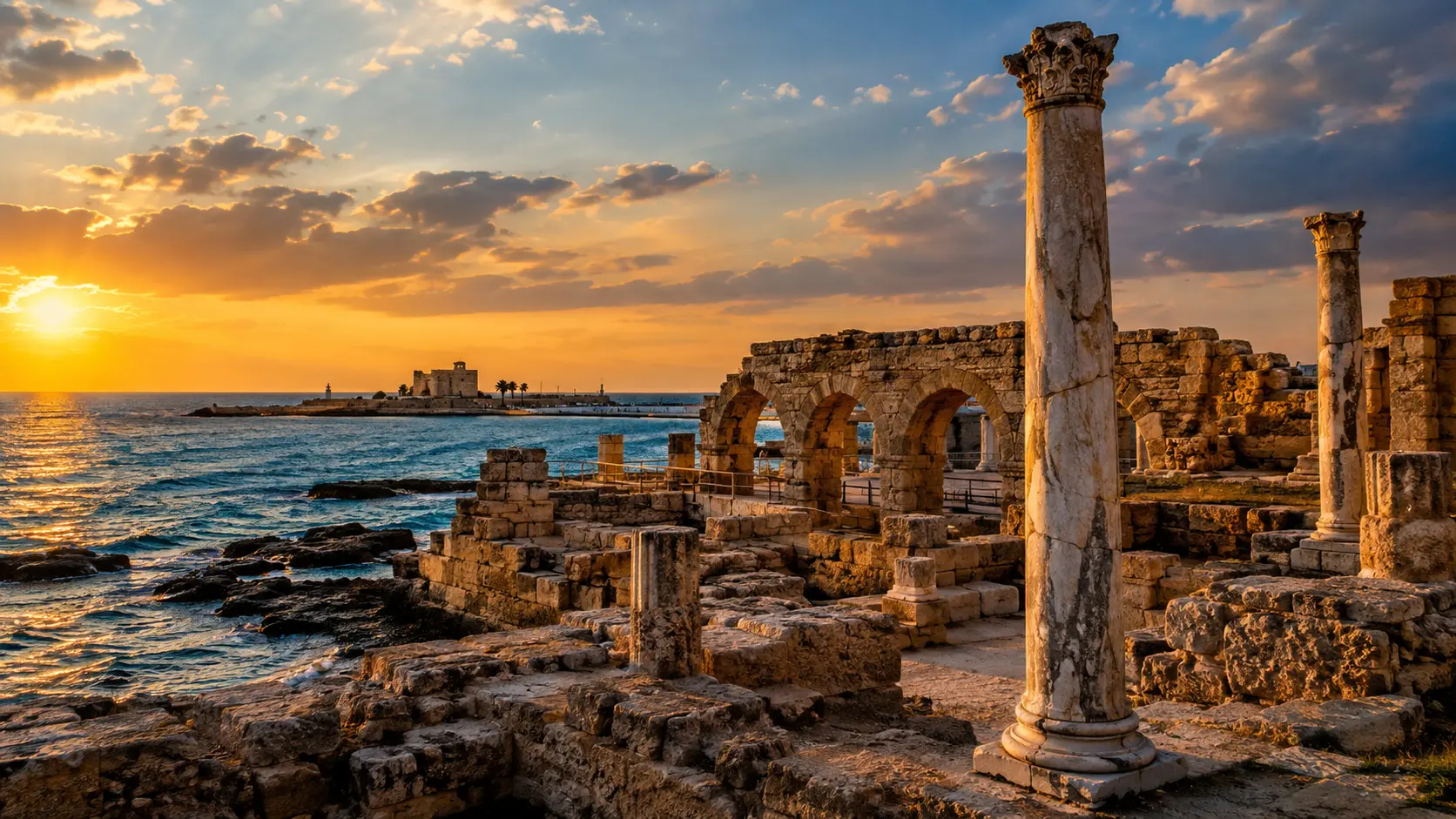 Ruins of the Roman theatre along the Mediterranean coast in Caesarea Maritima.
The governor’s official residence once housed Pontius Pilate—a detail of historic significance, as the sole archaeological inscription confirming his existence outside biblical texts was uncovered among these ruins. This location also served as the prison of Saint Paul when he exercised his right as a Roman citizen to appeal his case to Caesar (Acts 25).
Haifa and Mount Carmel
Israel’s third-largest city is built along the slopes of Mount Carmel (which is actually a coastal mountain range). The earliest documented settlement in the area dates back to the Late Bronze Age (14th century BCE). Throughout the centuries, Haifa passed through the hands of Phoenicians, Persians, Hasmoneans, Romans, Byzantines, Arabs, Crusaders, Ottomans, the British, and Israelis. Today, it stands as a major seaport and home to two world-renowned academic institutions: Haifa University and Technion (Israel Institute of Technology).
Our route afforded panoramic views of the city and its harbor before ascending Mount Carmel. En route, we visited the Terraces of the Bahá’í Faith, surrounding the Shrine of the Báb. A security guard at the entrance reminded visitors that this was a sacred site; smoking and chewing gum were strictly forbidden, and modest attire was required (long trousers for men, long skirts or pants for women). It was notable how respectfully visitors complied with these guidelines, contrasting with the frequent pushback seen at Christian holy sites.
Unfortunately, the Stella Maris Carmelite Monastery was closed during our visit, leaving the acquisition of Carmel scapulars for a future journey. However, we were able to enter the Church of Elijah’s Cave, where tradition holds that the prophet Elijah prayed before confronting the prophets of Baal (1 Kings 18).
Saint John of Acre (Akko)
This was the city’s name during the Third Crusade. To Israelis, it is known as Acre (Akko), its biblical designation. We toured the Citadel of the Hospitaller Knights, exploring the dungeons, refectory, Knights’ Hall, and surrounding chambers.
Following this extensive journey along the coast, we proceeded toward Tiberias on the shores of the Sea of Galilee, which served as our base for the next two days.

Diosnel Herrnsdorf
Head Sommelier & Travel Curator at Fast Track Travel. Passionate about discovering unique terroirs and craft spirits.